


by Claudia Schrauwen, Faculty of Pharmaceutical, Biomedical and Veterinary Sciences, University of Antwerp We’ve long thought about how participation in science communication…
Modern-Day Alchemy Could Stem the Rising Cost of Drugs
Recently, we have experienced the rising costs of everything from movie tickets to eggs. Many of us can’t help but feel pained when the check arrives after eating at our favorite restaurant. It is enough to wish we could be like Alchemists from old stories, turning lead into gold. While we might groan at the gas pump or the register of a grocery store, one necessity has seen an absurd rise in costs long before the others: prescription medication. From 2021 to 2022, while general inflation increased by 8.5%, the average increase of 1200 tracked prescription drugs rose 31.6%! Some of these prescription drugs increased by 500%. The cost of medications and medical care has long been debated in the United States, and most agree something must be done to curb this incredible increase. Fortunately, computational or in silico alchemy may be able to help.
Deloitte, a consulting company, points to the staggering costs of drug development for the rapid increase in drug prices. Many different groups have measured the cost of drug development. Deloitte places the cost of developing a drug from discovery through clinical trials to markets at 2.3 billion in 2022 dollars. The Journal of the American Medical Association published a study on the investment needed to bring a new medication to market from 2009-2018, focusing on 63 new medications. It estimated a median cost of 1.1 billion dollars across this period. A 2014 study by Tufts estimated that it cost nearly 3 billion in today’s dollars.
From 2021 to 2022, while general inflation increased by 8.5%, the average increase of 1200 tracked prescription drugs rose 31.6%!
The Journal of American Medical Association study that estimated the development cost revealed that cancer drugs were the costliest to develop, especially when accounting for drugs that failed to come to market. This problem is multiplied when accounting for the fact that there are over 200 different kinds of cancers, along with a massive global increase in the incidence of cancer cases. One 2018 study reported 18 million new cancer cases and almost 10 million deaths in one year alone. The need to develop safe, effective treatments to combat this health challenge continues to be urgent. With the traditional pipeline taking 12 years and billions of dollars, new research methods are needed to reduce costs and speed prescription drug development.
Along with the 1-to-3-billion-dollar expense, a drug takes approximately 12 years to reach the market, another contributing factor to the high cost. A group of British researchers at the British Medical Journal disagree that the development cost is the main driver for the rise in spending, citing that while the largest biopharma companies spent a collective 1.4 trillion on development, they spent a staggering 2.2 trillion selling these drugs. However, despite the conclusion that sales costs are to blame for increases, the British Medical Journal researchers agree with the Deloitte company that the high research and development cost must be addressed.
This is where alchemy comes into play. While chemical alchemy may not be possible, computational scientists have figured out how to transform one molecule into another and mathematically compute important chemical properties between molecules. They’ve shown that this approach can be used to perform computer-aided drug design and help reduce costs by accelerating discoveries.

Image credit
Interior of an Alchemical Laboratory by Wellcome Library, London, CC BY 4.0
Although a seemingly new concept of the computer age, computer-aided drug design was developed in the 1970s, and its theoretical roots date back to the early 20th century. The recent rise in these methods is partly due to the widely available powerful GPUs and the availability of 3D structures of clinical targets obtained with x-ray crystallography methods.
Computer-aided drug design speeds up drug discovery in many areas. For example, after identifying a focus target, an experimentalist must devote time to conducting an assay to look for compounds that successfully bind to the target. This can take a whole team of traditional experimentalists years to complete. A computational method known as virtual screening can use libraries of known small molecule structures and virtually test them against the drug target. Thousands of compounds can be tested this way in a relatively short time by a single scientist, saving thousands of people and experiment hours.
Once a compound is identified, it will go through a process called lead optimization, which is a process that will improve how well the compound binds to the target and improve its preference for the drug target. Learn more about the drug discovery process here. Lead optimization is an essential part of the process that increases a drug’s effectiveness and minimizes side effects.

Image credit
"2022 Data Center" by Jefferson Lab is marked with Public Domain Mark 1.0  .
.
It is at this point in the process that modern-day alchemists are essential. Alchemy may invoke pictures of wizards with pointed hats and long beards rather than state-of-the-art computational modeling. However, alchemy’s central theme embodies turning one substance into another. In mythology, this was lead into gold. In computational drug design, this is typically some structural modification to a compound, such as changing one functional group into another. Within the computational simulation, one compound bound to the drug target can be turned into a similar but structurally different compound to compute relative binding affinities and predict which molecule binds better. These calculations are known as alchemical free energy calculations. Their use is becoming more widespread, and success stories are more numerous in the drug discovery field.
As of November 2021, over 70 FDA-approved commercial drugs used some computational technique during their discovery process. In most of these drugs, initial screens to identify drug hits utilized computational techniques. The number of drug discoveries driven by computational methods will continue to rise. For instance, Schrödinger, a company that created one of the most popular software to perform these alchemical transformations, recently announced a lymphoma treatment going to clinical trials. They used computational methods and machine learning to test more than 8 billion compounds, synthesize an unheard-of small number of 80 compounds, and test within ten months. Contrast a typical industry experimental approach that screens only 200,000 to 1 million compounds and synthesizes hundreds of compounds in 4 years. Computational methods can drastically shorten the research period before clinical trials.
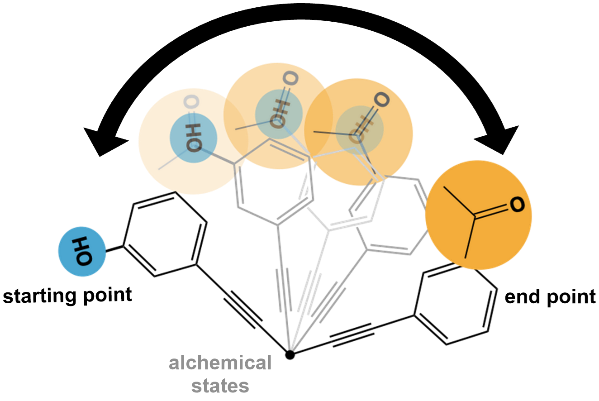
Image credit
Photo Courtesy of the author
Schrodinger’s work also shows the viability of using modern-day alchemy to help stem the extreme cost of drug development. The incredible cost of the drugs and their development is a multi-faceted problem and will need a combination of solutions. Still, the computational techniques of modern-day silicon alchemists could help reduce these costs, even if they aren’t turning elemental lead into gold.